
The process
Confirm the design
Review deck suitability, drainage, loads, access and the specified roof assembly.
Why it matters
The whole system must fit the building and project requirements.
Commercial · Austin & Central Texas
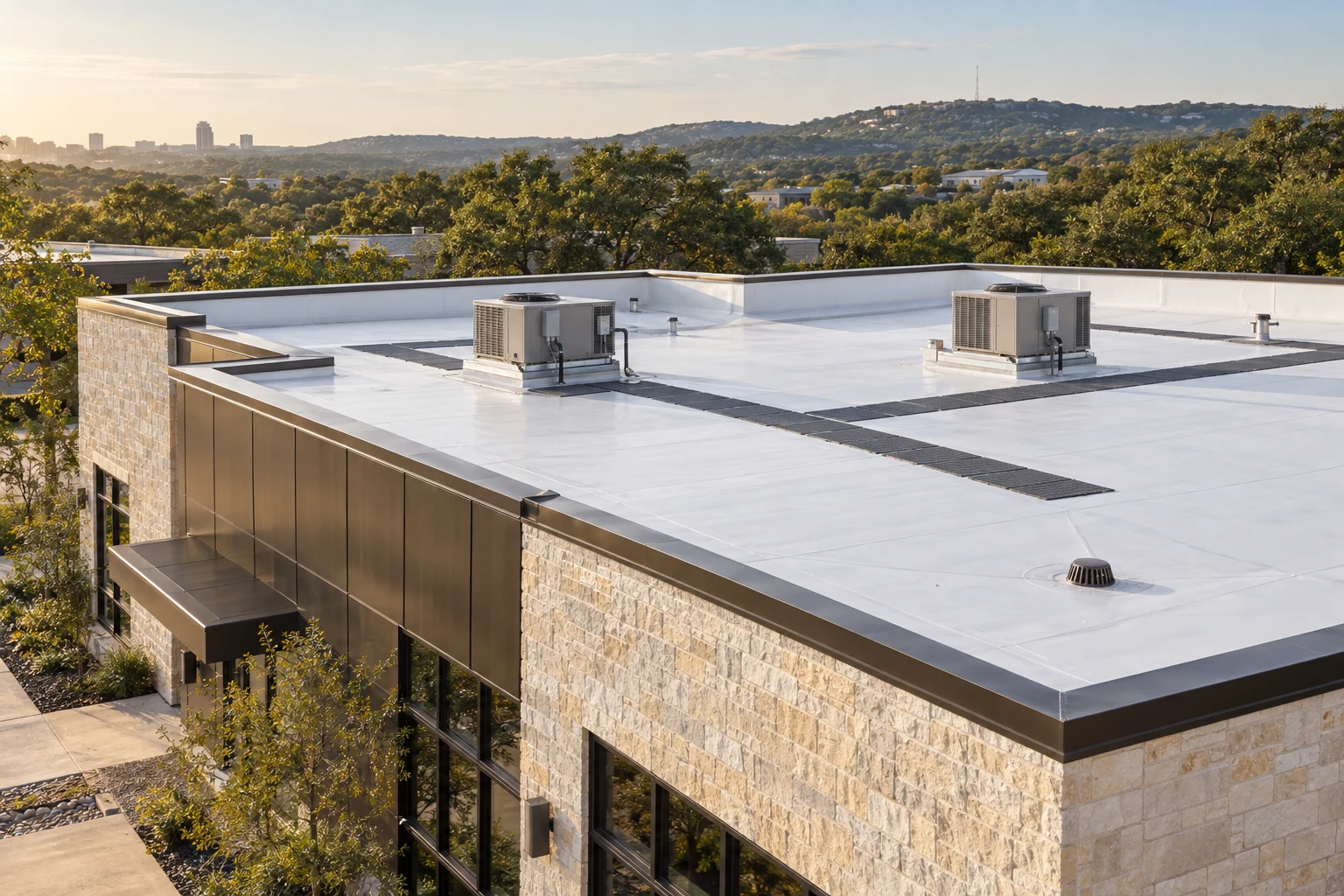
A new commercial roof brings structure, thermal performance, drainage and weather protection together. Coordinate the assembly early with the designer, building team and rooftop equipment layout.
The process
Review deck suitability, drainage, loads, access and the specified roof assembly.
The whole system must fit the building and project requirements.
The process
Install the specified insulation arrangement and taper where designed.
Thermal performance and drainage depend on the assembly.
The process
Add the specified cover board and attachment appropriate to the deck and design.
A suitable substrate supports the membrane system.
The process
Place and attach the selected membrane using its approved installation method.
The illustration uses single-ply roofing; systems are not interchangeable.
The process
Form seams, flash curbs and penetrations, and connect the perimeter and drainage details.
Continuity at transitions is essential to roof performance.
The process
Complete required inspections and provide project and warranty documentation.
A documented handover supports future maintenance.
Explore the stages or pause to read.
Talk with our team · (512) 910-4110
The commercial details
Use the project-specific assembly and attachment design; perimeter and corner requirements may differ.
Coordinate slope, outlets, insulation and the applicable energy requirements.
Plan equipment curbs, penetrations, staging and protection before roof work begins.
Before work begins
Confirm the roof system, site access, authorized decision-makers and the work included. Agree on protection, staging, tenant communication, cleanup and documentation.
Plan the next stepBefore you decide
Compare the building use, deck, drainage, chemical exposure, attachment options and maintenance needs with the design team.
No. The illustration explains a typical sequence. Use the selected product documents, project specifications and local requirements.