Storm season · Austin & Central Texas
Hail damage roof repair in Austin
Hail bruises shingles, cracks tiles and dents vents, gutters and other soft metal, and much of that damage cannot be seen from the ground. Texas Professional Roofing starts every hail repair in Austin with a free, no-obligation roof inspection that photographs the damage with dates, then puts the repair scope in writing before any work begins.
What does hail do to a roof?
Hail bruises shingles, cracks tiles and dents soft metal, and much of it cannot be seen from the ground. A bruised shingle can look intact from the yard. Look for the collateral signs you can see safely: dented gutters, downspouts and vents, and granules collecting at the downspouts.
A storm can bring wind as well as hail. Wind can lift shingles, loosen roof edges and expose vulnerable flashing, so a storm inspection checks those details alongside the hail damage and any existing wear.
When is hail season in Austin?
In NOAA storm reports for Travis and Williamson counties, 77.4% of hail reports from 2011 through 2025 came in March, April and May; see Austin hail season data. Those records hold 465 hail reports for the two counties from 2011 through 2025, an average of 31 a year, and the range between years is wide: 5 reports in 2016 against 103 in 2023.
The largest hail NOAA recorded there since 2011 was 4.0 inches, reported at Round Rock on September 24, 2023 and Coupland on May 30, 2024. 75.4% of the reports were 1 inch or larger, the size NOAA’s Storm Prediction Center treats as severe. The NOAA hail data page has the month-by-month and year-by-year tables.
How does a hail damage inspection work?
A free, no-obligation hail inspection walks the roof and photographs what it finds, with dates: impacts on the shingles, damaged flashings and vents, marks on gutters and other soft metals. You get the photo documentation and a written repair scope. Read what a free roof inspection in Austin covers.
Before anyone is on the roof, stay off it yourself. Note the date and time of the storm and photograph what you can see safely from the ground. Keep those photographs and the inspection report together with the storm date.
Should hail damage be repaired, or the roof replaced?
A localized defect on an otherwise serviceable roof usually suits a targeted repair, as long as the fix ties into the existing roof and compatible materials are available. Widespread deterioration, repeated leaks in different places, brittle shingles or damage to the deck change that decision. We do not push a replacement when a repair will do: the inspection establishes the affected area first, and you compare the written options before deciding.
If the findings point to a full roof, see how a roof replacement in Austin is planned, or measure your roof with the free roof calculator before the conversation.
Will my insurance pay for hail damage?
That is your insurer’s decision, not ours. Read your policy for its deductible and its notice requirements, and contact your insurer about the storm. We give you the roofing side of the file: dated photographs of the damage and a written repair scope. Your insurer decides coverage and payment. Texas law does not allow a roofing contractor to act as your public adjuster or negotiate your claim; we document and repair the roof.
See how our roof insurance inspections document the roof, or what to do next if your roof claim was denied.
Do impact-rated shingles stop hail damage?
Impact-rated shingles come up often after a hail storm. A Class 3 or Class 4 rating describes a laboratory impact test, not immunity to hail. Compare the exact product’s technical sheet and warranty terms, and ask your insurer whether that product qualifies for any premium credit. Of the 302 records in our published project catalog, 38 are installations of Class 3 or Class 4 impact-rated shingles. Read more about Class 3 and Class 4 impact-resistant shingles.
What hail-damage projects have we documented?
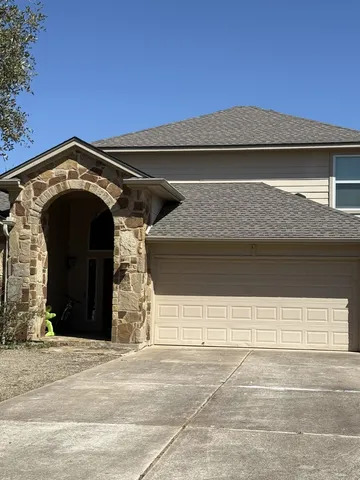
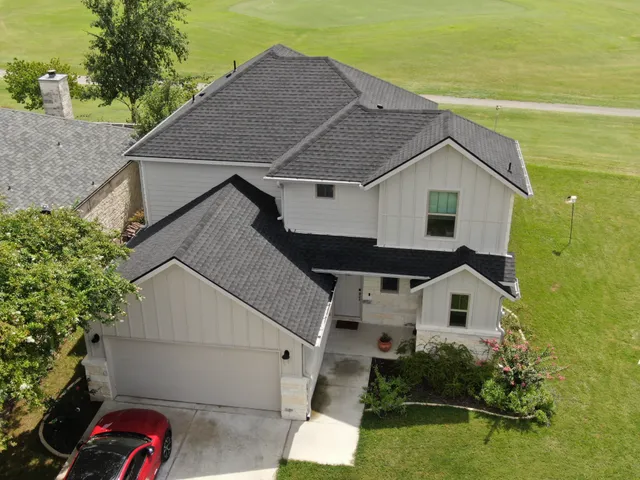
Our published project catalog (copy retrieved October 29, 2026) holds 6 records whose titles name hail damage as the reason for the work. Titles do not always name the reason, so that is a lower bound. 3 of them are below.