
Trace the likely source
Review reported symptoms and accessible roof details. Where appropriate, compare interior observations with the exterior pathway. Explain uncertainty and any further access needed.

Small details. Important protection.
A roof is more than its shingles. The connections around walls, chimneys and openings need to shed water as a complete assembly.
Texas Professional Roofing helps identify the roofing concern, explain the findings and define a practical flashing repair. Start with an inspection—not an assumption that you need an entirely new roof.
Request a flashing inspectionKnow the vulnerable connections
Conceptual inspection map · Red highlights selected connections, not installation dimensions.
Base and counterflashing work together around the chimney. A review should distinguish a roof-junction problem from masonry, crown or chimney-cap defects.
Step flashing integrates with successive shingle courses. The wall’s water-resistive layer must also drain correctly over the flashing.
At the lower end of a roof-to-wall junction, a properly integrated diverter directs runoff away from the wall and toward the gutter.
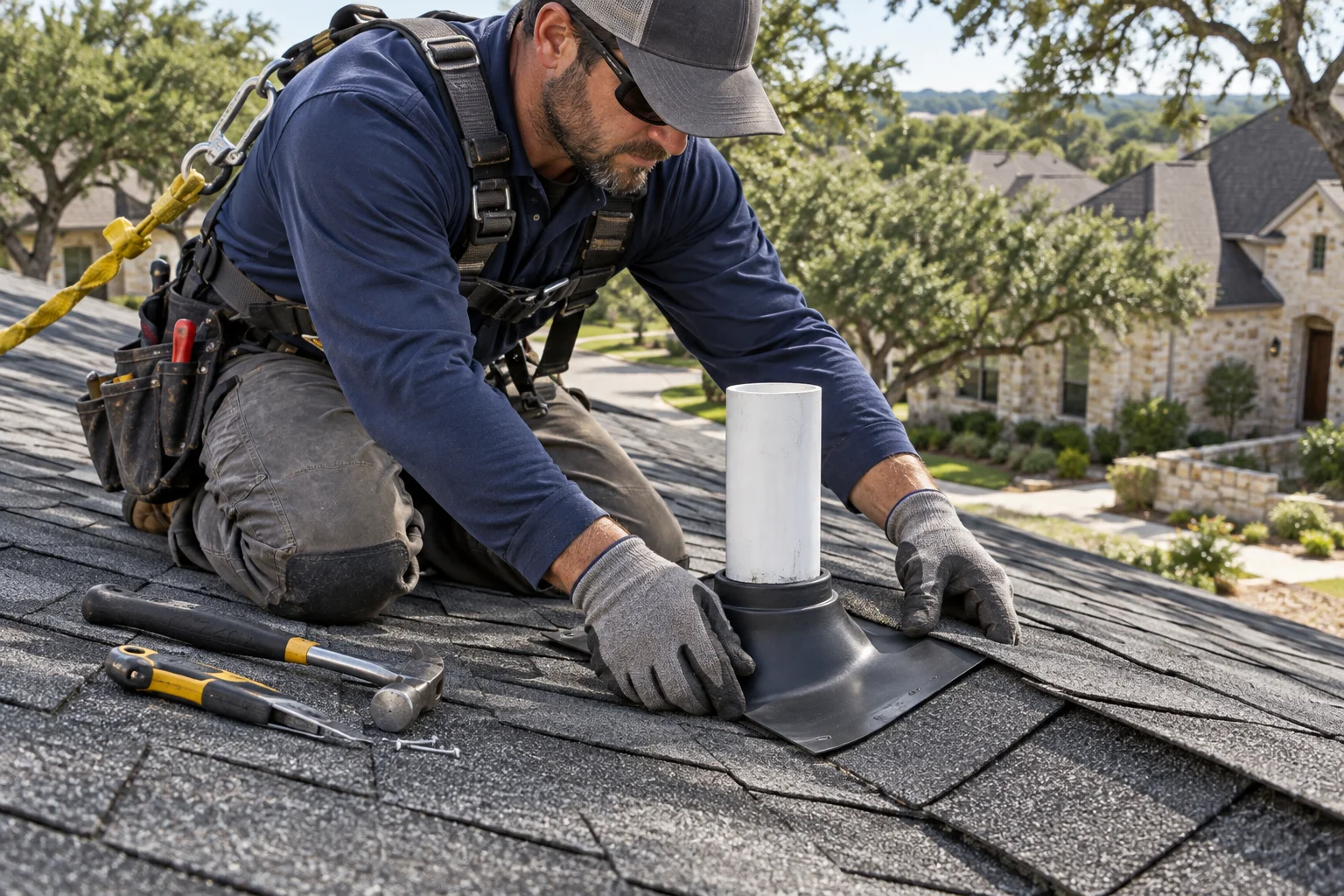
Pipe boots, collars and skylight flashing systems need compatible details. A failed seal or damaged component can create a localized entry point.
Concentrated runoff and perimeter transitions need the correct detail for the roof covering. Open and closed valleys are different assemblies.
Repair the detail, not just the symptom
Sealant can have a legitimate role in a manufacturer-specified detail. But missing pieces, incorrect overlaps or damaged materials need an appropriate repair strategy. Ask what the work will restore and whether any temporary protection needs follow-up.
What to ask about your proposalOur approach
Tell us when the problem appears, which room is affected and whether the roof, chimney or siding has been worked on recently. Safe photographs and previous repair records help establish the starting point.
 Talk through your roof concern
Review reported symptoms and accessible roof details. Where appropriate, compare interior observations with the exterior pathway. Explain uncertainty and any further access needed.
Record the affected junction, visible deterioration and surrounding roofing condition. Distinguish the roofing repair from related masonry, siding, plumbing or interior work.
Choose compatible materials and a detail suited to the roof covering and adjoining wall or penetration. Follow manufacturer instructions and applicable local requirements.
Carry out the agreed repair, reinstate affected materials and review visible drainage and flashing details. Any testing must suit the assembly and site conditions.
Explain the work completed, any remaining concerns and the applicable written terms. Keep the roofing records for future maintenance or related repairs.
Before work begins
A clear proposal makes the scope visible—even when the flashing itself will be concealed.
Explore budget & payment planningA localized concern
A sound surrounding roof may allow a focused flashing repair. The inspection establishes whether the necessary connection can be restored without wider work.
Repeated symptoms
Recurring stains deserve a fresh investigation. Previous repairs, hidden layers and adjoining wall details may affect the next step.
Planning replacement
Discuss the treatment of existing flashing before reroofing. Do not leave concealed details or assumptions about reuse out of the written plan.
Explore replacementStay away from wet electrical fixtures and sagging ceilings. Photograph symptoms only from a safe location and call the team to discuss access and next steps. Do not climb onto a wet roof.
Call (512) 910-4110Straight answers
Flashing is a weather-shedding detail at roof joints, edges and penetrations. It commonly uses metal and works with the roof covering and water-control layers to guide rain away from vulnerable connections.
No. Water can travel before becoming visible inside. Shingles, plumbing, condensation, masonry and other sources may also be involved. The inspection should trace the likely pathway rather than assume the stain is directly below the entry point.
Often a localized repair can be considered, depending on access, surrounding materials and the condition of the assembly. Brittle shingles, concealed damage or poorly integrated wall details may require a wider scope.
Sealants can be part of a specified detail, but they do not replace missing flashing, correct laps or sound materials. Ask whether the proposal restores the drainage detail or provides only temporary protection.
Some connections are hidden beneath the roof covering or wall cladding. Limited removal may be needed to inspect and properly integrate the repair. The proposal should explain access, reinstatement and how concealed damage is handled.
Coverage depends on the policy, cause of damage and insurer’s assessment. We can document roofing findings and provide an estimate; we do not guarantee coverage or negotiate a claim settlement for you.
Location, roof access, material compatibility, repair length, surrounding shingles or cladding, and hidden deterioration affect the scope. Get a property-specific written estimate rather than a price based only on a photograph.
Austin & Central Texas
Tell us what you have noticed. We’ll help you understand the roofing work your home needs.
Request a flashing repair inspectionCall (512) 910-4110Technical references reviewed September 13, 2026: GAF: Proper flashing · Building America: Step and kick-out flashing · DOE: Kick-out flashing.
Related services: Roof repair · Maintenance · Roofing & insurance help.
Where we work
Our office is in Northwest Austin. Open your area for the local roofing guide, documented projects nearby and the details that change a roof in that city.
Explore every service area and local guideRoofing answers
Yes. We provide professional roof repair services in Austin, including leak repairs, missing shingles, flashing repairs, storm damage repairs, and preventative roofing maintenance for residential and commercial properties. Learn more about our roof repair services .
A leak or damaged shingle does not automatically mean a full replacement. The extent of damage, condition of the surrounding roof and practicality of repair should guide the decision. Explore repair options
Yes. We offer free roof inspections in Austin and surrounding areas for storm damage, aging roofs, leaks, real estate transactions, and insurance claim evaluations. Schedule a professional roof inspection in Austin .
Answers last reviewed .